
I never really wanted to do research. During my neuroscience degree (and honestly, most of my dietetics degree), I had zero interest in it. Research sounded… boring. But then I enrolled in a course on the gut microbiota to fill up space in my schedule, and suddenly found myself fascinated. The microbiota is incredible and impacts everything we do (did you know humans have more bacterial cells in their bodies than human cells?? Are we even human? That’s probably a question for my philosopher partner lol) — our behavior, metabolism, growth, immunity, and even mental health. And the best part is that we barely even understand it yet, which means maybe I could actually contribute to a very cool and growing field. For the first time, research didn’t sound like the worst idea — especially if I could do grad school and keep working (because, money).
It also helped that my twin sister had just finished her MSc and very confidently (and repeatedly) told me: “You should do a Master’s — it’s easy, you barely have to do any work.” Easy? Barely any work? You get paid? AND I could keep working on the side to make more money?? Perfect. Sign me up.
So, I applied to work with Dr. Raylene Reimer and ended up with a project looking at how birth mode (vaginal vs. C-section) impacts the gut microbiota, how the early-life gut microbiota affects development and risk of anxiety and depression, and whether nutrition could help fix these abnormalities. Nutrition, gut bacteria, and mental health? Perf. But let me tell you… it was not easy. And working 5-7 days a week while I did it didn’t help, but again, I am not rich so you do what you have to. Nonetheless, it was fun, rewarding, stressful, very cool, and extremely exhausting. I got to design my own study from scratch, build materials, collect and analyze data, run behavior testing, and care for around 100 rats. And, if I do say so myself, I think I found some pretty cool stuff (more on that later).
One of the most unexpected outcomes of my MSc was discovering how much I loved the rats. My participants weren’t humans — they were rats, and it turns out rats are the sweetest, loveliest little creatures. Because of the type of behaviour testing I did I needed to make sure they were comfy with me, so that meant handling all of them every day or two so they knew we were friends. I adored caring for them and getting to know their little personalities. The flip side? “Sacrificing” (AKA murdering) them for tissue collection. That part was awful — there were always tears involved and it gave me anxiety and nightmares for months. While I loved working with rats, I certainly never want to be in a position where I have to hurt one again.
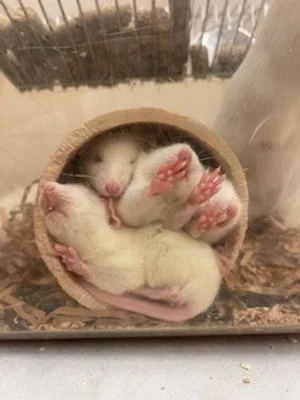
Adorable babies cuddling in their tube
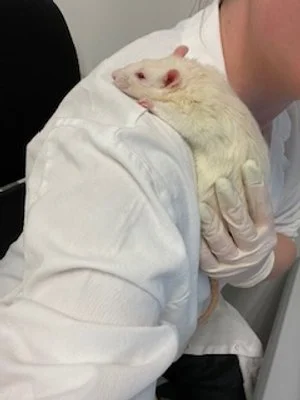
Quick snuggle during body composition analysis
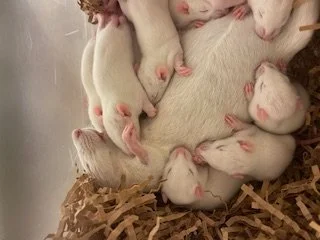
A sweet mama feeding her babies
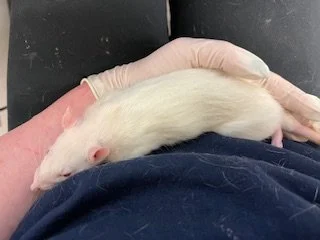
Christmas eve with the rats - no complaints about hanging out with these little guys though
Grad school also came with some adventures. There were stretches where I had so much work I literally didn’t have time to go home before I had to be back in the lab. Most people in that situation would crash at a friend’s place near campus (especially since I had one who offered). But where’s the fun in that? Instead, I often just slept in my car. Fine in the summer… a little less fun in -40°C winters… and definitely less fun the night campus security woke me up at 3:30 a.m. (after my glorious 75 minutes of sleep) to inform me I wasn’t allowed to sleep in the parking lot. They were very concerned I was homeless. And while I tried to convince them otherwise, the pile of blankets, clothes, a mattress, and — yes — a kettle in the back seat didn’t exactly strengthen my case. Luckily, they didn’t push it and eventually just left me alone.
Despite the exhaustion, it was an amazing journey. I met incredible people and even a long-lost relative (who, fun fact, worked in the same rat building as me, mostly at night to avoid people). I learned how to perform a C-section on a rat, helped milk rats, worked in a germ-free facility where animals have absolutely no bacteria in or on their bodies, and even started (loosely) plotting to convince the government of Alberta that rats are not evil. Alberta is famously “rat-free” and has an actual rat patrol — yes, really — but maybe one day research rats could be adopted out, just like mice, hamsters, and rabbits are.
Grad school turned out to be nothing like the “easy, no work” version my sister promised me — but it was so much better. Exhausting, yes, but also eye-opening, inspiring, and completely worth it. And one of the biggest lessons I learned? I want to keep doing it. So stay tuned to see if I get accepted to my PhD — and hopefully, this time, with far fewer nights sleeping in my car.
